
About
Home » Computer Engineering
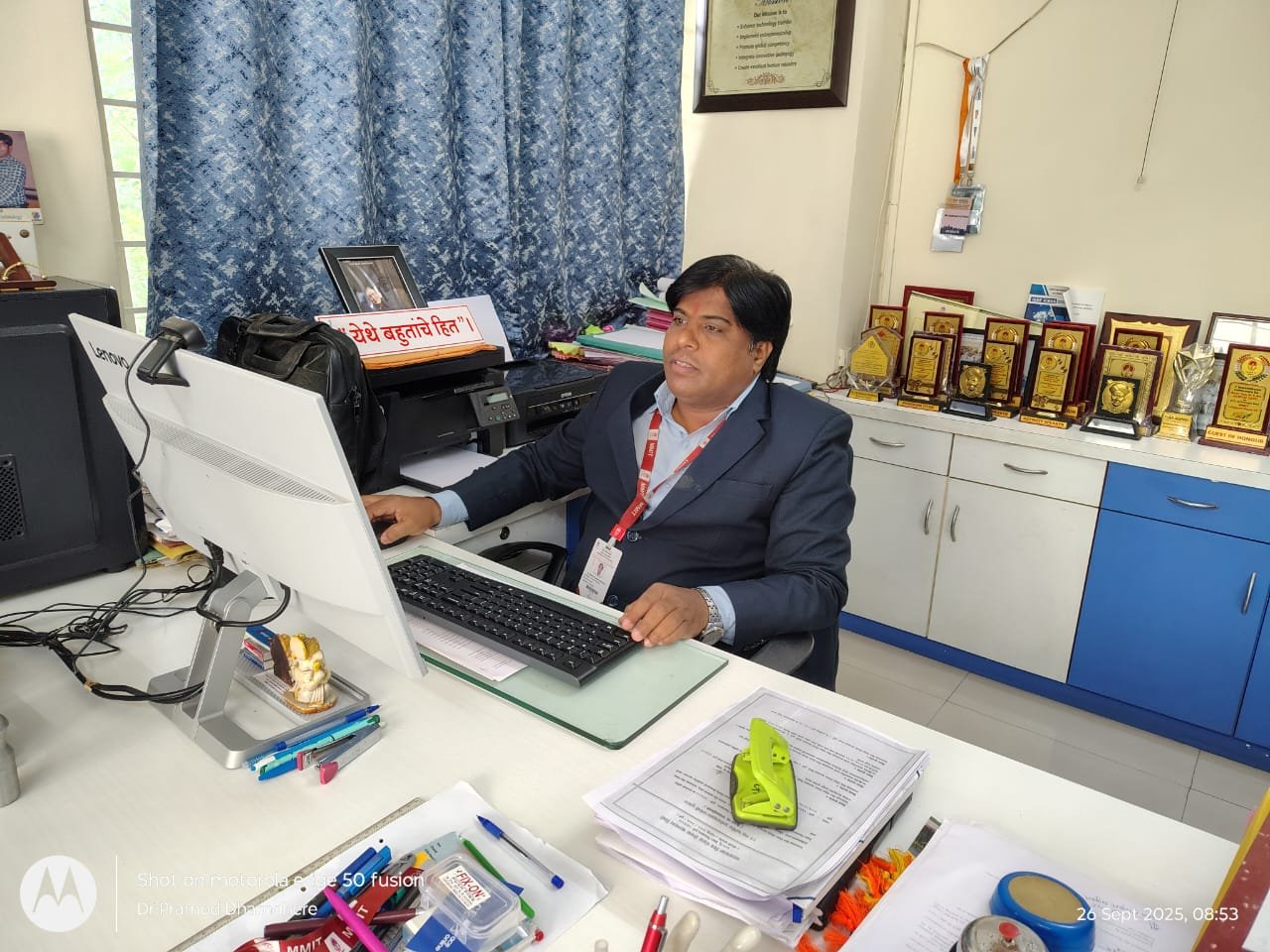
Prof. Dr. Subhash G. Rathod
Head of the Department
Welcome to the Department of Computer Engineering at Marathwada Mitra Mandal’s Institute of Technology, Pune. Today as we are moving towards 4th Industry revolution & we all are fining many changes over the decades. Digitization and Automation is the heart of 4th Industry revolution & hence computer engineering becomes Ubiquitous! As college location is in the area of IT Hub and many opportunities related to career in IT which makes the future not only bright but also creative and productive of students pass out from MMIT.
Department of computer engineering consistently strive not only hardly but also with passionate towards high quality of education with state of art infrastructure..
Department of computer engineering associated with various industry and training partner like ICT Acadmy, Redhat Pvt Ltd, Microsoft Pvt. Ltd., Animationwala Pvt. Ltd. and many more thought which students get real industry exposure and knowledge while leaning in the Institute.
Department having more than 10 patents, many International and National Journal Published in reputed journal.
We the faculty of department not only educate the students but also committed for overall development of students and always motivate them for solving societies problem though real time problem solving skills. As our alumna working on highest positions in corporate as well as public sectors.
All the Best!!!
Department Highlights
- Industry-Oriented Curriculum aligned with current industry needs.
- Active IEEE & IEI Student Chapters for technical and professional growth.
- Virtual Labs Nodal Centre recognized by IIT Bombay.
- Internship & Placement opportunities.
- Excellent Placement Support with leading IT companies.
- Project-Based Learning with hands-on experience.
- Student Mentor System for academic and career guidance.
- Strong Industry Connect through visits, internships, and live projects.
- Regular Workshops, Seminars & Expert Talks by industry professionals.
- Hackathons & Coding Competitions to enhance technical skills.
- Japanese & German Language Training for global careers.
- Value-Added Certification Programs in emerging technologies.
- Skill Development Programs for technical and soft skills.
- Active Student Clubs & Professional Bodies to build leadership and teamwork.
- Research & Innovation Culture with patents and publications.
- Modern Computing Laboratories with advanced infrastructure.
- Outcome-Based Education (OBE) with continuous improvement.
- Participation in National & International Competitions.
- Entrepreneurship & Startup Support through innovation initiatives.
- Academic Mentoring & Remedial Support for student success.
- Hands-on Training in AI, ML, Cloud, IoT, Cyber Security, and Data Science.
- Holistic Development through co-curricular and social activities.
- Focus on Ethics, Leadership & Lifelong Learning.
- The department has Granted Patents ,Published Patents, Copyrights.
VISION
To achieve techno-social excellence by fostering innovative, sustainable and ubiquitous computing solutions for societal needs
MISSION
- Providing quality education in computing through innovative pedagogy and research.
- Promoting innovation and creative thinking in technology-driven studies.
- Encouraging real-world application of evolving technological trends.
- Developing industry-ready competencies among graduates
Program Educational Objectives (PEOs)
-
PEO1: Graduates will apply foundational knowledge of mathematics, science, and computer engineering to solve complex and computing problems. -
PEO2: Graduates will design, develop, and deliver innovative, sustainable, and industry-ready computing solutions using standard software engineering practices -
PEO3: Graduates will demonstrate ethical, social, and professional responsibility by integrating techno- social awareness and sustainable practices into engineering solutions. -
PEO4: Graduates will exhibit personal integrity, professional competence, teamwork, and leadership qualities to contribute effectively in multidisciplinary environments and to society.
Knowledge and Attitude Profile (WK)
-
WK1: A systematic, theory-based understanding of the natural sciences applicable to the discipline and awareness of relevant social sciences. -
WK2: Conceptually-based mathematics, numerical analysis, data analysis, statistics and formal aspects of computer and information science to support detailed analysis and modelling applicable to the discipline. -
WK3: A systematic, theory-based formulation of engineering fundamentals required in the engineering discipline. -
WK4: Engineering specialist knowledge that provides theoretical frameworks and bodies of knowledge for the accepted practice areas in the engineering discipline; much is at the forefront of the discipline. -
WK5: Knowledge, including efficient resource use, environmental impacts, whole-life cost, re-use of resources, net zero carbon, and similar concepts, that supports engineering design and operations in a practice area. -
WK6: Knowledge of engineering practice (technology) in the practice areas in the engineering discipline. -
WK7: Knowledge of the role of engineering in society and identified issues in engineering practice in the discipline, such as the professional responsibility of an engineer to public safety and sustainable Development. -
WK8: Engagement with selected knowledge in the current research literature of the discipline, awareness of the power of critical thinking and creative approaches to evaluate emerging issues. -
WK9: Ethics, inclusive behavior and conduct. Knowledge of professional ethics, responsibilities, and norms of engineering practice. Awareness of the need for diversity by reason of ethnicity, gender, age, physical ability etc. with mutual understanding and respect, and of inclusive attitudes.
Program Outcomes (PO)
-
PO 1: Engineering Knowledge: Apply knowledge of mathematics, natural science, computing, engineering fundamentals, and an engineering specialization as specified in WK1 to WK4 respectively to develop solutions for complex engineering problems. -
PO 2: Problem Analysis: Identify, formulate, review research literature, and analyze complex engineering problems reaching substantiated conclusions with consideration for sustainable development (WK1 to WK4). -
PO 3: Design / Development of Solutions: Design creative solutions for complex engineering problems and design/develop systems, components, or processes to meet identified needs with consideration for public health and safety, whole-life cost, net zero carbon, culture, society, and environment as required (WK5). -
PO 4: Conduct Investigations of Complex Problems: Conduct investigations of complex engineering problems using research-based knowledge including design of experiments, modelling, analysis, and interpretation of data to provide valid conclusions (WK8). -
PO 5: Engineering Tool Usage: Create, select, and apply appropriate techniques, resources, and modern engineering and IT tools, including prediction and modelling, while recognizing their limitations to solve complex engineering problems (WK2 and WK6). -
PO 6: The Engineer and The World: Analyze and evaluate societal and environmental aspects while solving complex engineering problems for their impact on sustainability with reference to economy, health, safety, legal framework, culture, and environment (WK1, WK5, and WK7). -
PO 7: Ethics: Apply ethical principles and commit to professional ethics, human values, diversity, and inclusion while adhering to national and international laws (WK9). -
PO 8: Individual and Collaborative Team Work: Function effectively as an individual and as a member or leader in diverse and multidisciplinary teams. -
PO 9: Communication: Communicate effectively and inclusively within the engineering community and society at large, including the ability to comprehend and write effective reports and design documentation and make effective presentations considering cultural, language, and learning differences. -
PO 10: Project Management and Finance: Apply knowledge and understanding of engineering management principles and economic decision-making to one’s own work, as a member and leader in a team, and to manage projects in multidisciplinary environments. -
PO 11: Life-Long Learning: Recognize the need for and have the preparation and ability for (i) independent and life-long learning, (ii) adaptability to new and emerging technologies, and (iii) critical thinking in the broadest context of technological change (WK8).
Programme Specific Outcomes (PSOs)
-
PSO1: Apply analytical and programming skills using open-ended environments to design, implement, test, and deliver solutions -
PSO2: Develop effective solutions using standard software engineering principles and life-cycle practices aligned with industry standards